Surface curvature and secondary vortices
in dense shallow granular flows
The University of Manchester


Upward curvature of the flow surface
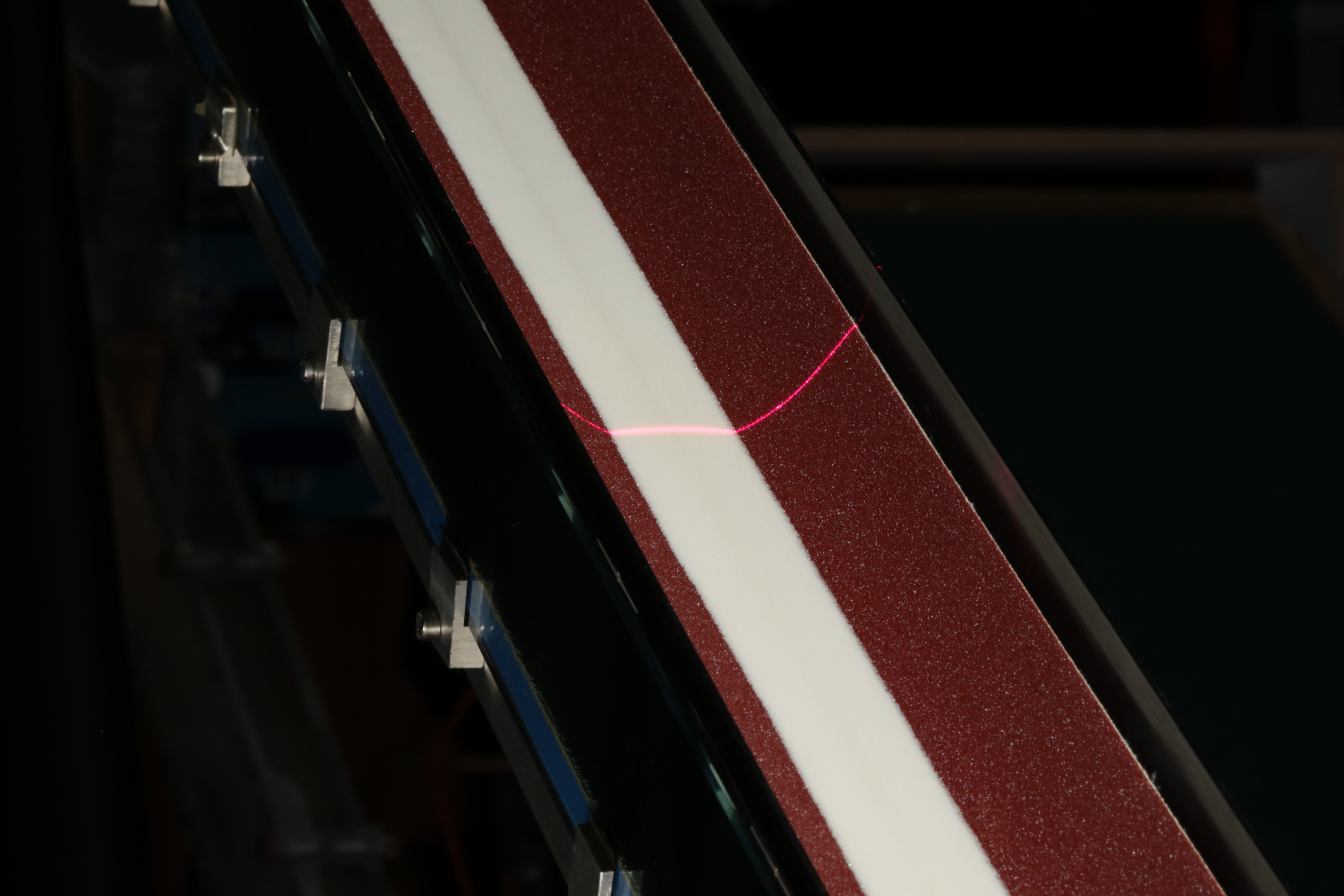
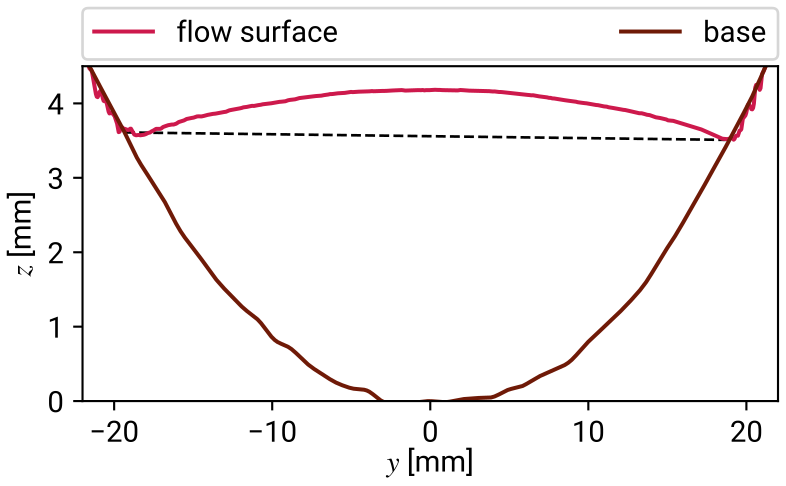
Can not be obtained with standard \(\mu(I)\) rheology! What’s missing?
Normal stress differences
Complex fluids: \(\sigma_{xx} \neq \sigma_{yy} \neq \sigma_{zz}\) Normal stress differences
\(\mathcal{N}_{1} = \sigma_{xx} - \sigma_{zz}\) tension along streamlines
\(\mathcal{N}_{2} = \sigma_{zz} - \sigma_{yy}\) compression perp. streamlines
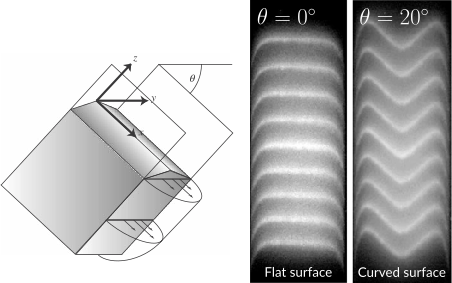
Second normal stress difference in granular flows
Grain scale simulations
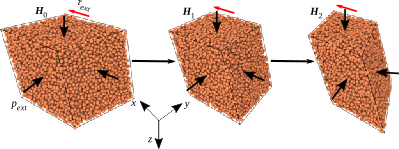
(Srivastava et al. 2020)
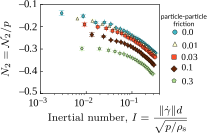
(Srivastava et al. 2020)
second-order granular rheology
\(\sigma = -p \left(I_{3} + \displaystyle\frac{\mu(I)}{\lVert\dot{\gamma}\rVert}\dot{\gamma} + \displaystyle\frac{N_{2}(I)}{\lVert\dot{\gamma}\rVert^{2}}\left[\dot{\gamma}^{2} - \displaystyle\frac{1}{3}\text{tr}\left(\dot{\gamma}^{2}\right)\right] \right)\)
Summary of the mathematical modelling
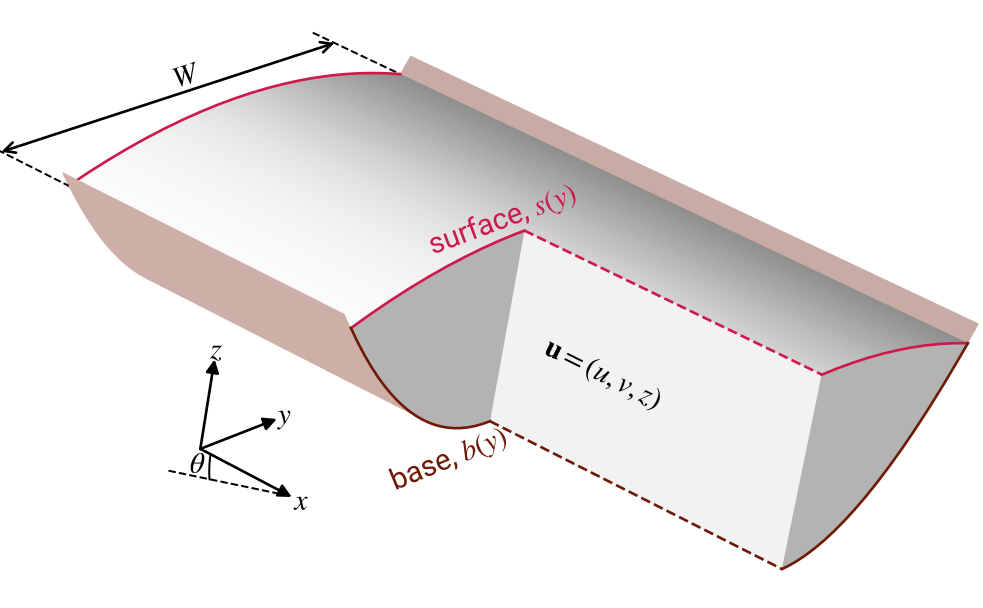
Summary of the mathematical modelling
Assumptions
- steady, incompressible, uniform in \(x\)
- a single average grain size, \(d\)
- shallow \(\epsilon = H/W \ll 1\):
\(\begin{aligned} \mathbf{u} & = u^{(0)} \mathbf{e}_{x} + \epsilon \mathbf{u}^{(1)} + \epsilon^{2} \mathbf{u}^{(2)} + ... \\ p & = p^{(0)} + \epsilon p^{(1)} + \epsilon^{2} p^{(2)} + ... \\ & \qquad \vdots \end{aligned}\)
Mass conservation
\(\nabla \cdot \boldsymbol{u} = 0\)
Momentum conservation
\(\rho (\boldsymbol{u} \cdot \nabla)\boldsymbol{u} = \nabla \cdot \boldsymbol{\sigma} + \rho\boldsymbol{g}\)
Second-order granular rheology
\(\boldsymbol{\sigma} = -p \left(\mathbf{I}_{3} + \displaystyle\frac{\mu(I)}{\lVert\boldsymbol{\dot{\gamma}}\rVert}\boldsymbol{\dot{\gamma}} + \displaystyle\frac{N_{2}(I)}{\lVert\boldsymbol{\dot{\gamma}}\rVert^{2}}\left[\boldsymbol{\dot{\gamma}}^{2} - \displaystyle\frac{1}{3}\text{tr}\left(\boldsymbol{\dot{\gamma}}^{2}\right)\right] \right)\)
\(\boldsymbol{\dot{\gamma}} = \left(\nabla\boldsymbol{u} + \nabla\boldsymbol{u}^{T}\right)\) and \(I = \displaystyle\frac{\lVert\dot{\gamma}\rVert d}{\sqrt{p/\rho_{\text{s}}}}\)
Boundary conditions
- no slip at the base: \(\boldsymbol{u}(b) = \boldsymbol{0}\)
- kinematic boundary condition: \(\boldsymbol{u}(s) \cdot \boldsymbol{n}_{s} = 0\)
- dynamic boundary condition: \(\boldsymbol{\sigma}(s) \cdot \boldsymbol{n}_{s} = \boldsymbol{0}\)
Assymptotic solution: first non-zero quantities
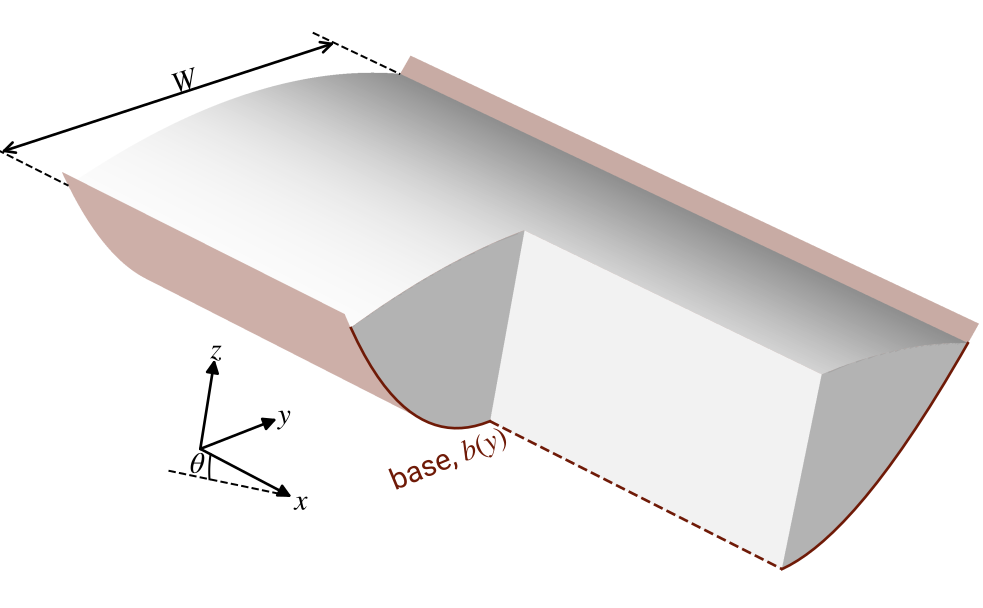
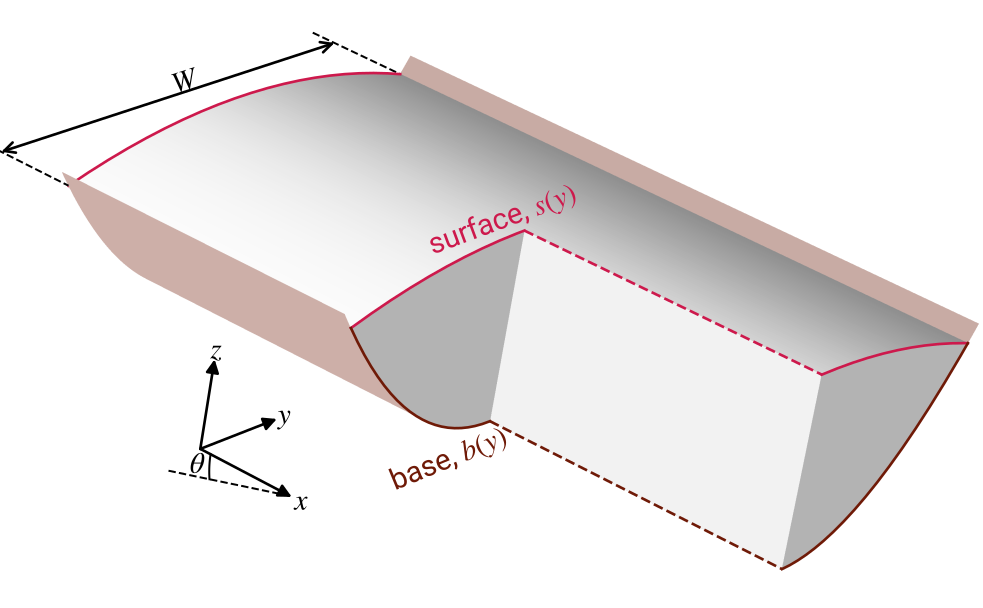
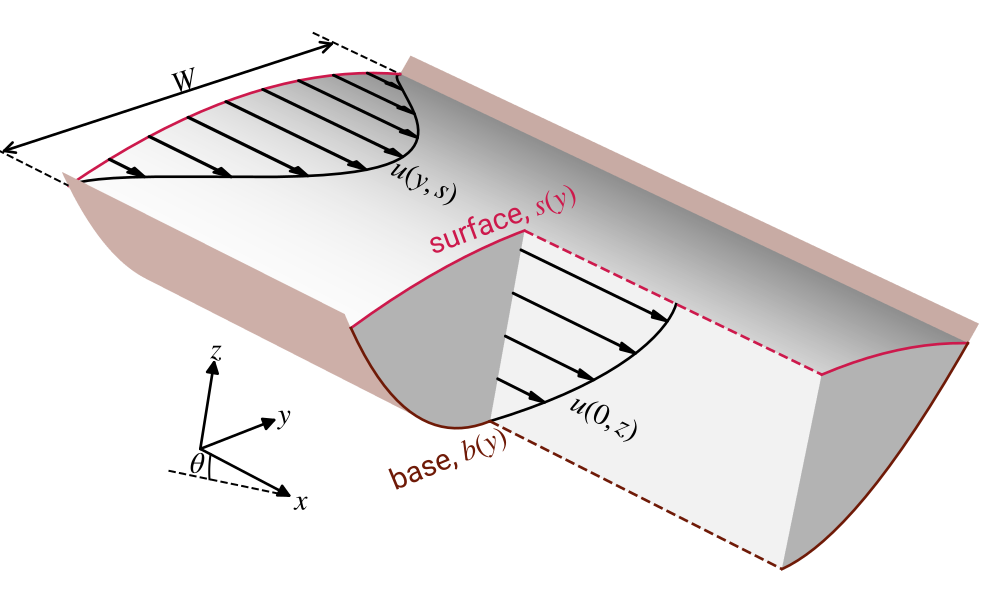
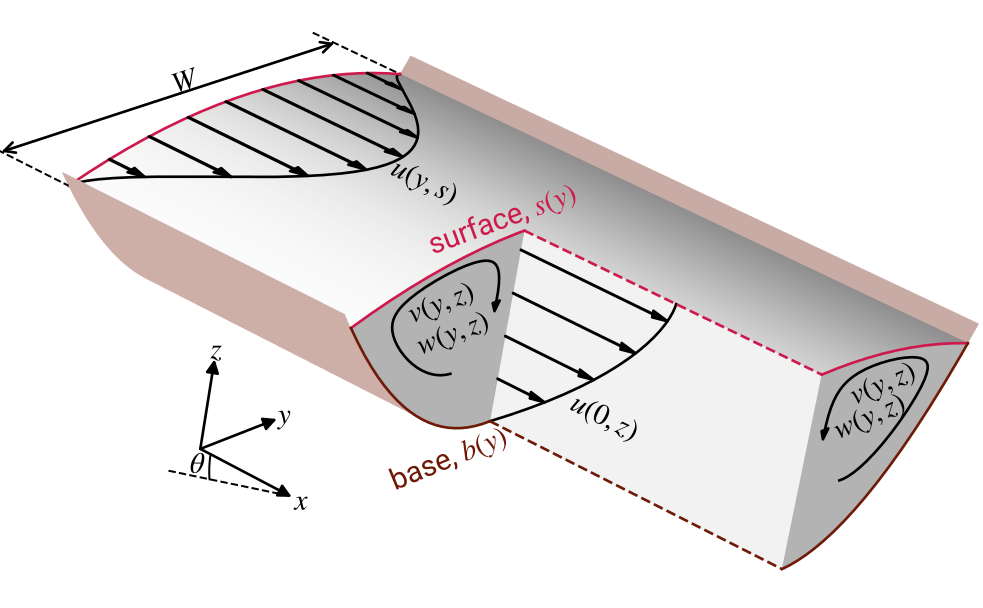
How to verify this solution?
Leading order
- \(s^{(0)}\): \(\displaystyle\frac{\text{d}}{\text{d}y}s^{(0)} = \displaystyle\frac{5 N_{2}}{5 N_{2} + 4}\displaystyle\frac{\text{d}}{\text{d}y}b\)
- \(u^{(0)}\): juxtaposition of Bagnold profiles
- \(p^{(0)}\): hydrostatic
Next orders
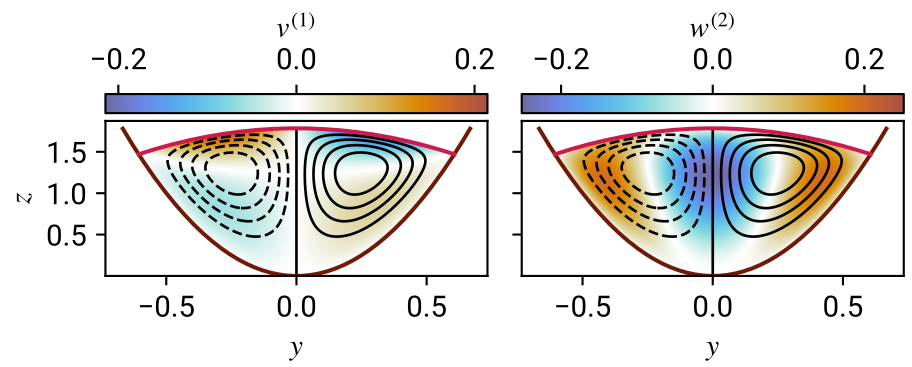
Secondary vortices
Validation using grain scale simulations (DEM)
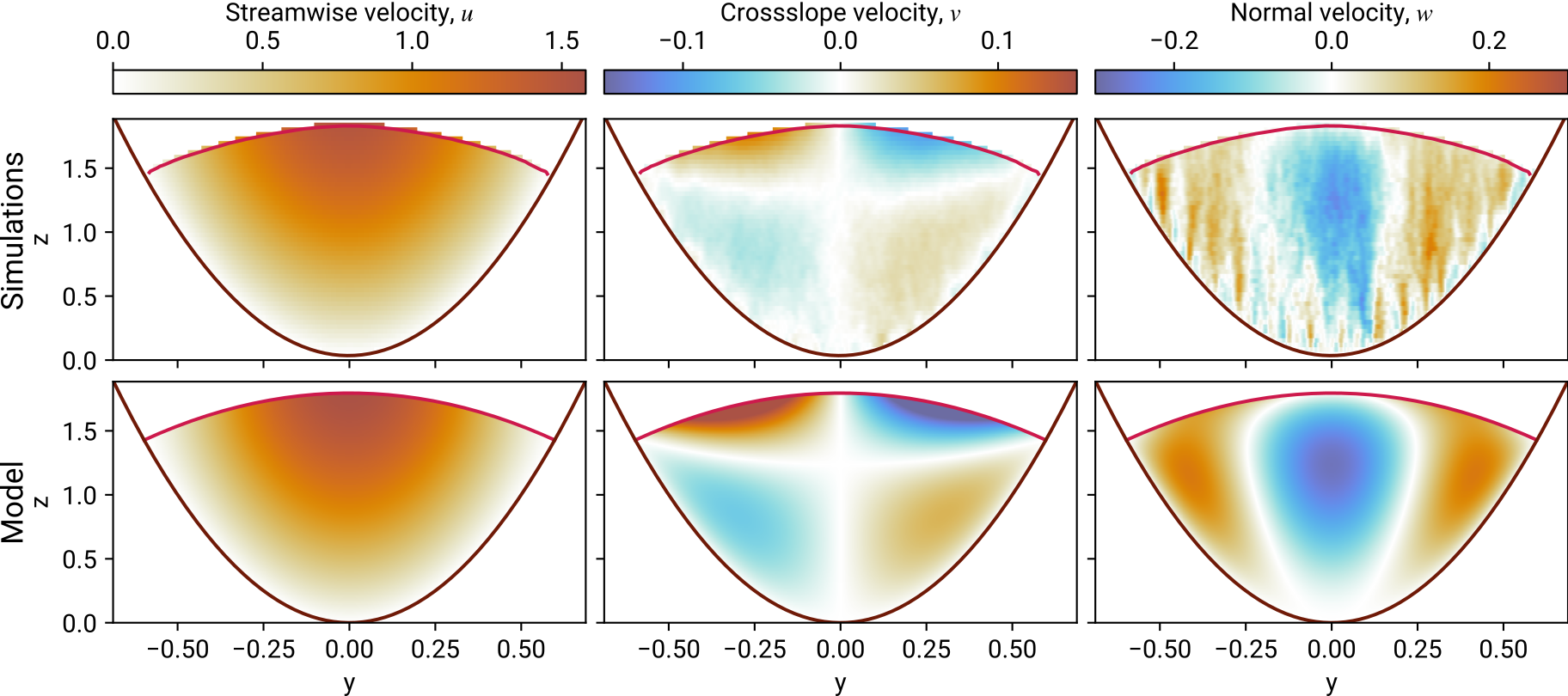
Good prediction of the flow structure
Validation using grain scale simulations (DEM)
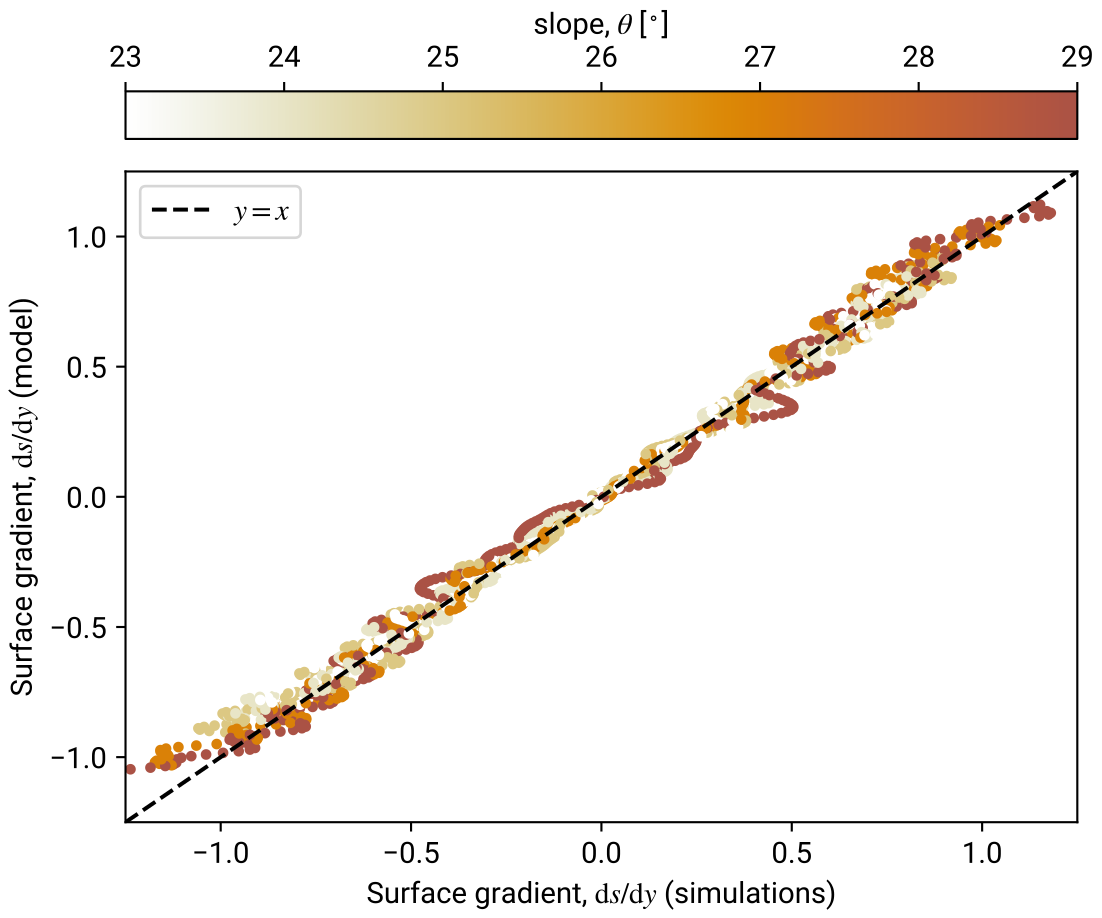
Excellent prediction of the surface shape
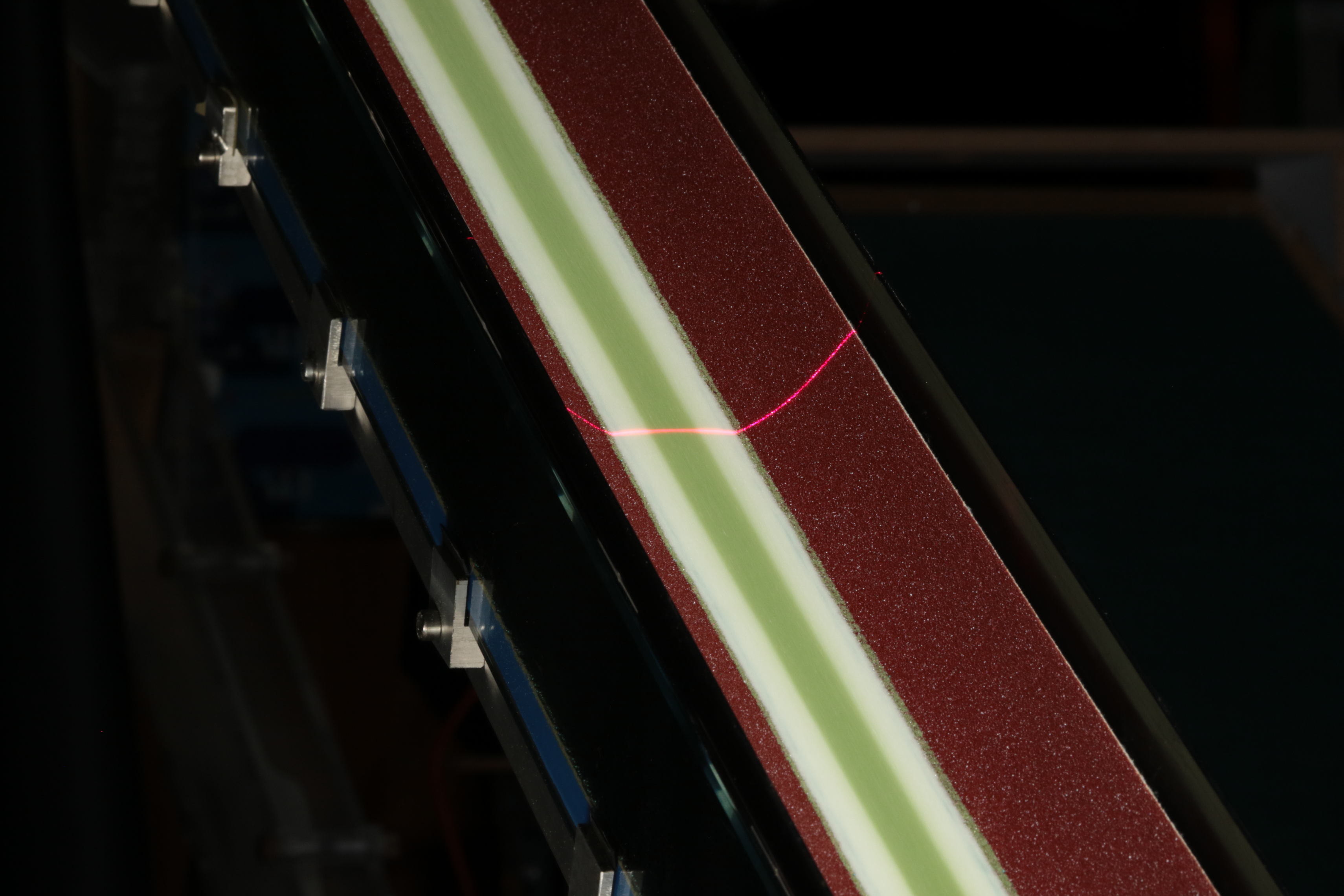
Back to the lab: inference of \(N_{2}(I)\)
- glass beads, \(d \sim 150\) microns
- slope angle, \(\theta\) control the inertial number, \(I\)
- mass flux, \(Q\) only scales up or down the velocity/flow depth
\(\displaystyle\frac{\text{d}}{\text{d}y}s^{(0)} = \displaystyle\frac{5 N_{2}}{5 N_{2} + 4}\displaystyle\frac{\text{d}}{\text{d}y}b\)
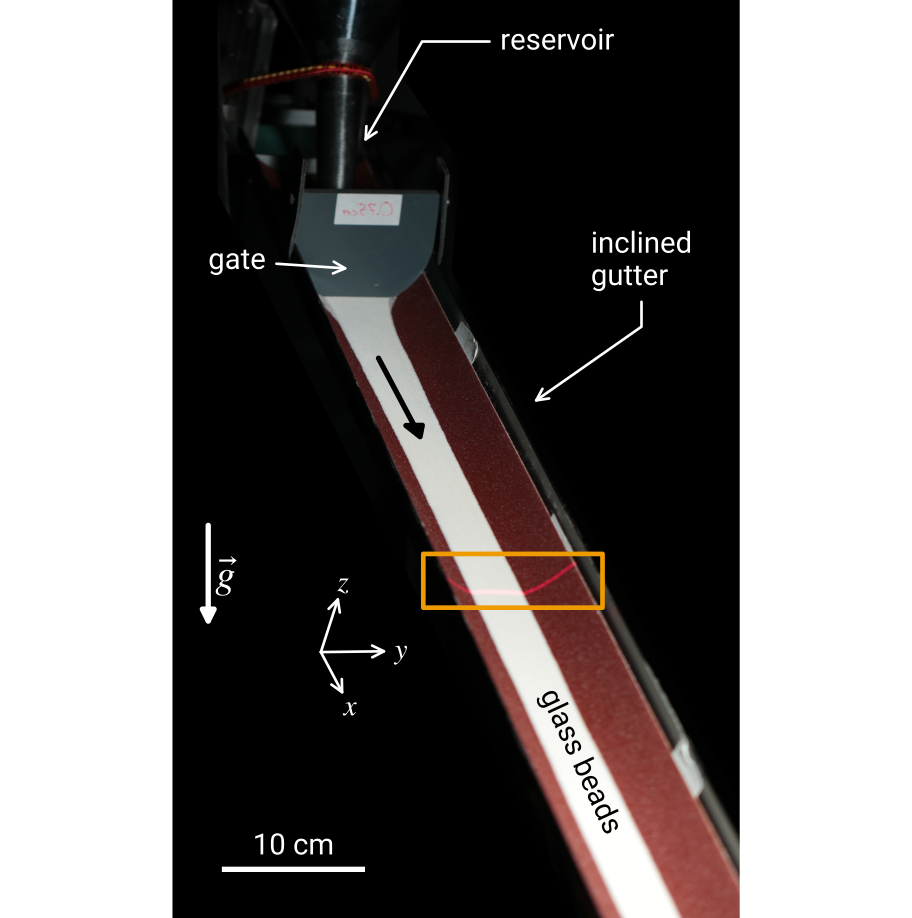
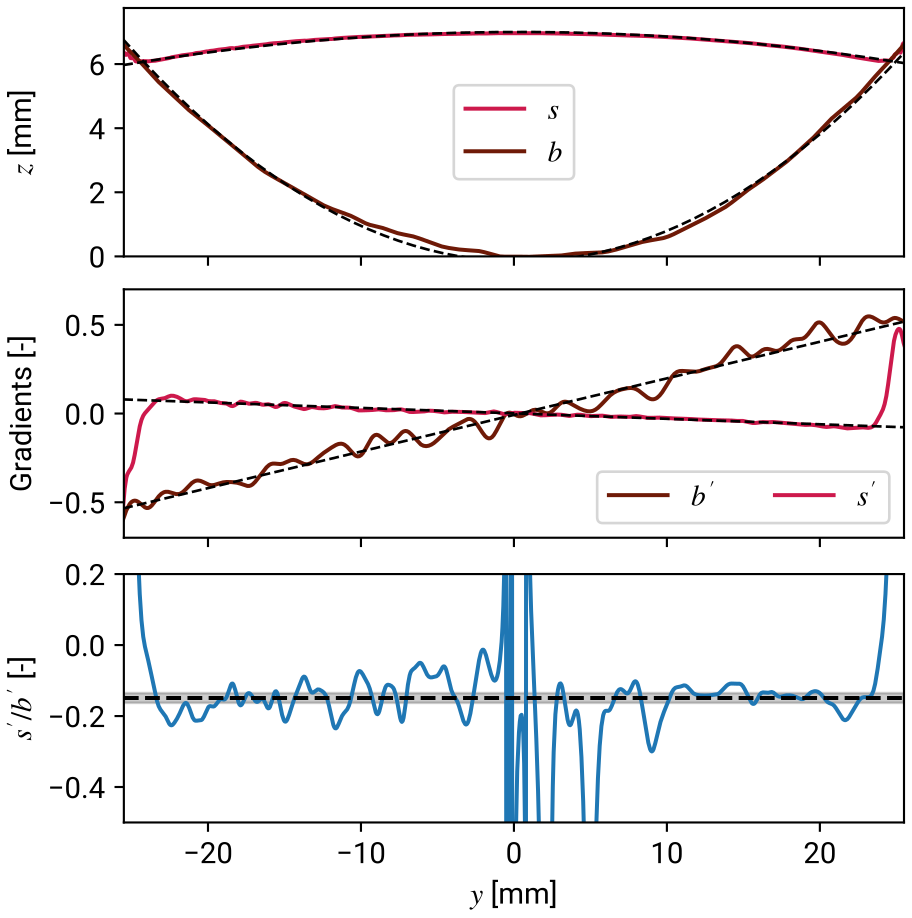
Back to the lab: inference of \(N_{2}(I)\)
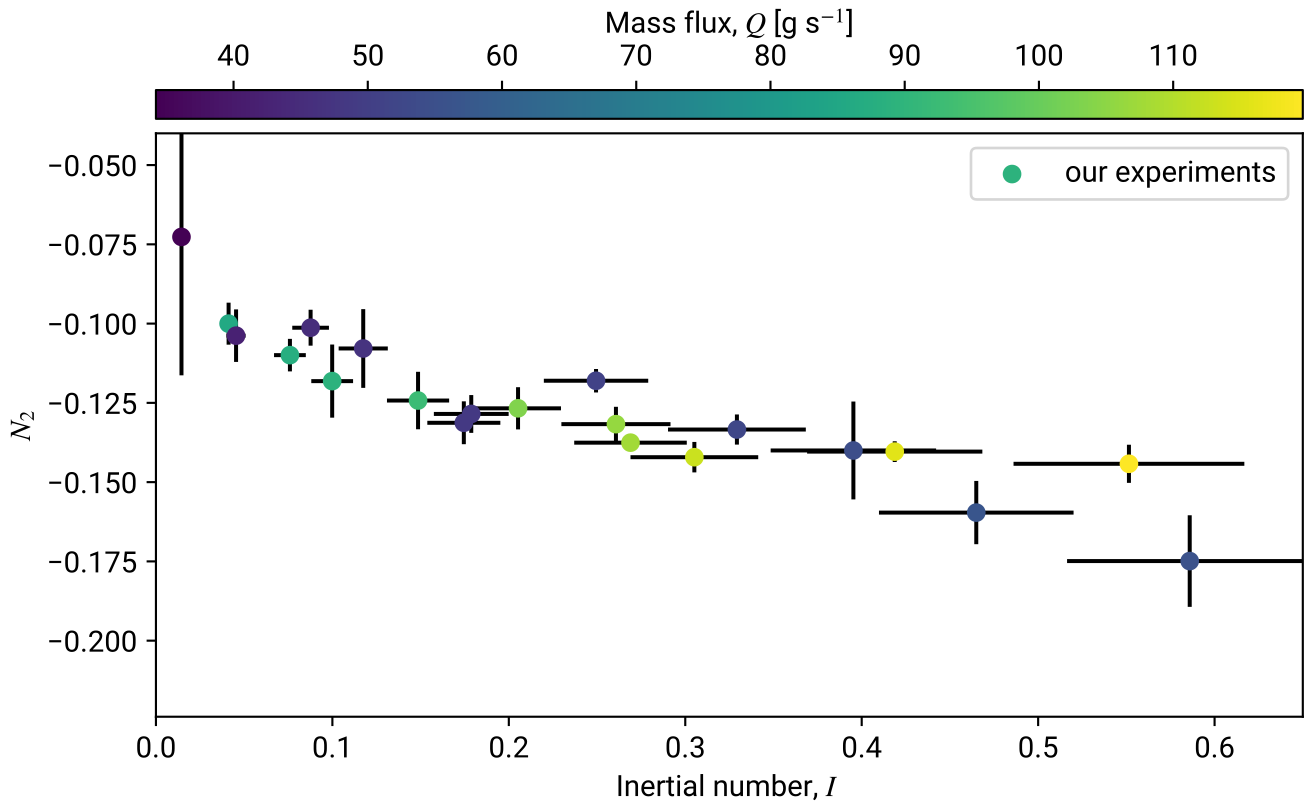
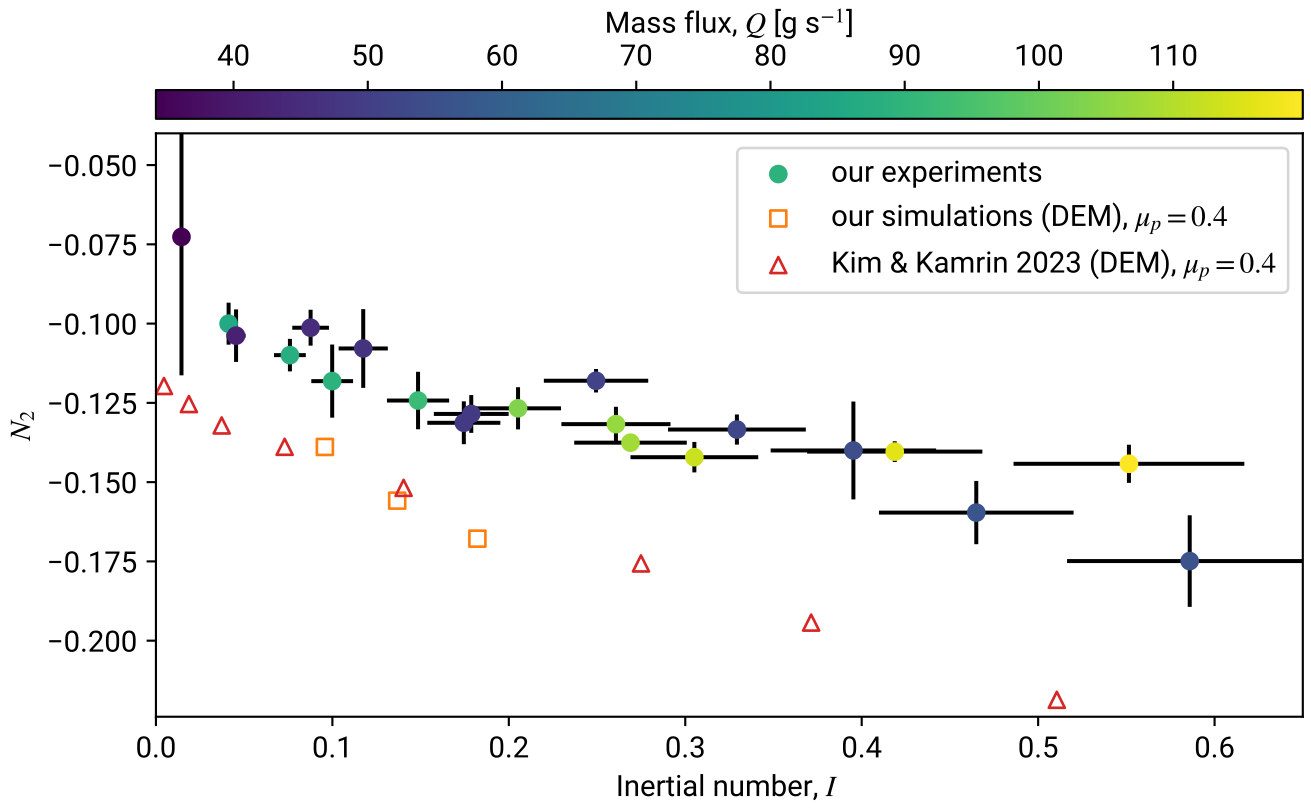
In a nutshell
second normal stress difference surface curvature and secondary flows in dense granular flows
mathematical model able to predict this quantitatively inference from experiments of \(N_{2}(I)\)
C. Gadal, C. J. Johnson C. J. and J. M. N. T. Gray. “Surface curvature and secondary vortices in dense shallow granular flows.” Submitted to Journal of Fluid Mechanics
Lateral segregation, stripes
Segregation in convecting granular flows
Amber Pearse
Tuesday - 16h40